

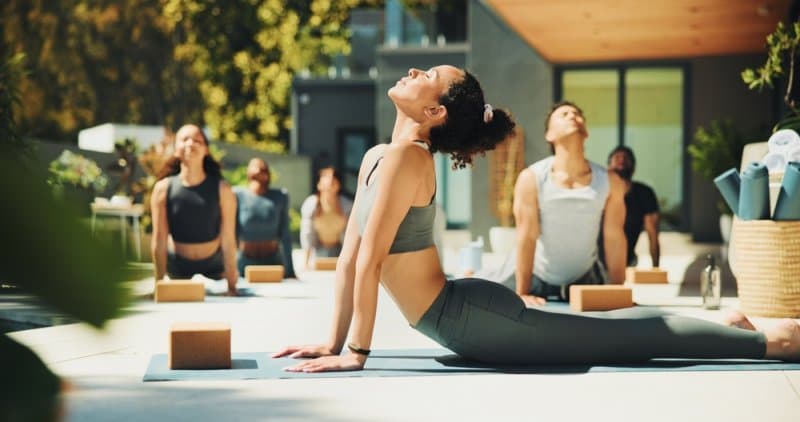
Stiffness can make simple daily tasks such as bending down to put on your shoes, reaching overhead, or standing up from a chair more difficult. But there are ways you can learn how to improve flexibility.
Improving your flexibility can allow you to move around more freely and keep a healthy degree of range of motion so you can carry out physical activity on a daily basis—all without buying costly workout gear or a gym membership.
You must be able to push into greater and greater ranges of motion as you seek to increase flexibility. Daily stretching routine and mobility work should be done by moving through the following pattern: stretch on a regular basis, strength train within a comfortable ROM, and use controlled, pain-free movements. The goal is to improve mobility without forcing movement.
Begin with brief sessions at your convenience. Flexibility exercises should be easily incorporated after a walk, after a workout, or during a rest period. Use a slow pace, normal breathing, and if you feel any sharp pain, numbness, or peculiar discomfort, then stop. The goal is to be regular, not to overstretch.
If you're a beginner to stretching, get started with easy exercises that work multiple muscles. Beginner flexibility stretches don't have to be painful—in fact, you should even feel a little tight. You don't need to touch your toes or practice advanced yoga poses.
Try these flexibility exercises for beginners:
Keep static stretches for 10-30 seconds initially, whatever feels right for you. Repeat on both sides of your body. Do not work to a 'muscle burn' or anything that causes pain; work to a point where you feel a good stretch, but increase the range of movement as you get better.
This will vary depending on the stiff area and the movement you want to be able to perform more easily. If you find it hard to bend forward, stretches that target the hamstrings may be effective. For those who sit at desks all day, stretches for the chest and shoulders may be beneficial. No exercise can do everything.
Some of the best stretches for flexibility to include in your routine are:
Pick three or four exercises appropriate to your needs and focus on them rather than trying to do too much too soon. Including some stretching exercises to improve flexibility and some controlled exercises to build strength can help you to learn how to move with greater control as your flexibility increases.
You can increase your flexibility at home using just a mat, a wall and a heavy chair to help support you. Having a specific area in your house for exercising can be advantageous but is not necessary. The key is to select exercises you can do safely and frequently enough to see improvements over time.
It doesn't take much to keep your flexibility in check—a few minutes of movement daily can help keep you flexible. Begin by walking or marching in place for a few minutes, then stretch your hips, legs, shoulders and back without bouncing or holding your breath.
Here's how to improve flexibility with daily stretching: a simple full-body stretch routine can include shoulder circles, the cat-cow pose, doorway chest stretch, hip flexor stretch, hamstring stretch, and a calf stretch. Repeat each static stretch for 15-30 seconds, and perform them on both sides if required. You can decrease the number of days you stretch if you start to feel sore.
For the majority of healthy adults, stretching multiple times a week is a reasonable place to start. Light mobility and stretching exercises that are comfortable on your body can be done every day, while more intense flexibility work should probably have a recovery day in between sessions. Frequency will depend on your overall activity level.
Before you dive into longer static stretches, do a warm-up. Especially pre-workout, you want to prioritize dynamic moves like controlled leg and arm swings. Do static stretching after a workout or as part of a dedicated stretching session. Never push a joint past its full range of motion and stop if you have an injury or medical condition.
After a few sessions, you might find that the stretches seem easier—but generally it takes weeks or even months to see the real benefits. How much better you'll be at it depends on your starting point, how much you move, your age, how often you practice, and which muscles you stretch.
Pay attention to measurable progress, rather than just how far you can bend. For example: Are you able to achieve a more comfortable bend? Is your head able to rotate even further? Are you more stable in a squat? As you get more flexible, increase your stretch gradually. Don't compare your progress to another person. It is optimal to be flexible if progress is gradual and pain-free.
Mastering flexibility involves making a habit of little, incremental progress, not quickly pressing into the splits. Use a combination of a mild stretch, mobility exercises, and slow and controlled strength movements to take your body to the edge of its comfortable range of motion.
Begin with a baseline, train consistently, and adapt as your body changes. Over time, the effort of moving day to day will feel lighter.
Yes. Yoga isn't the only way to get more flexible. You can also achieve it with a brisk walk, specific stretches, mobility work and strength training while staying in a pain-free range of motion. Just do what you enjoy so it's sustainable.
Neither makes sense for everyone: morning stretching, for example, could be a great way to get moving after a long night asleep, but evening stretching might work well as part of a routine to wind down. Whatever works for you.
Positions in some areas are difficult to hold comfortably if you have limited mobility, but it will also depend on your strength, habits and individual anatomy. Combining movement breaks, strengthening exercises and stretching may enable you to move more comfortably.
No. You should normally have just mild tension, not a sharp pinch or pain. If it aches to stretch, this can inflame your muscles, tendons, and/or joints. Come out of it, scale it back and seek advice from a professional.
Yes. Most older adults can and should stretch to improve or maintain flexibility. Do exercises that are appropriate to your level of balance, strength, flexibility, and general health. Use a chair or wall for support, and increase the stretch gradually.
This content was created by AI